
The Flowers of the Dichtersbuurt
OPENING OF THE CITIES, NOT SAUNAS MURAL
Cities, not Saunas
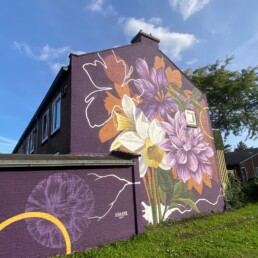
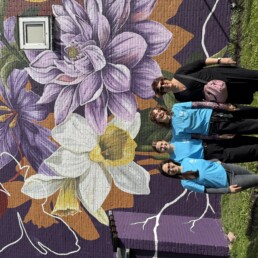
Every summer, heatwaves across Europe are getting more intense, and many of our homes and streets were never designed for them. Older people, women, people with disabilities or illness, and outdoor workers are hit hardest. Cities, Not Saunas, part of the Funding Fairer Futures project, raises awareness of extreme heat and promotes solutions like more urban greenery, shade, water and climate-resilient public spaces. Until now our focus has been on heat itself, but for this mural we wanted to show what a better future could look like. “Flower of the Dichtersbuurt”, painted by the artist duo Ciclope, does just that: a green, lively and welcoming neighbourhood, where greenery cools the streets and makes public space somewhere people want to be.
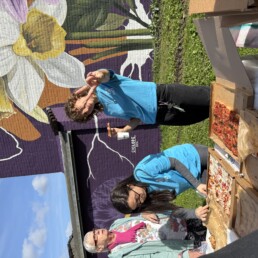
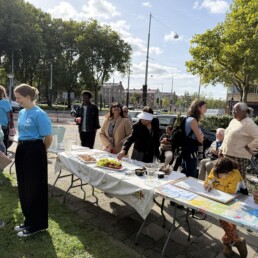
The neighbourhood is home to many compact houses and is set to change a lot in the coming years, so a pleasant, green outdoor space matters all the more for the people who live here. Last week, neighbours, friends and partners gathered for the opening, with drinks, great conversations and wonderful weather. The excitement in the neighbourhood was the best part of the day.
Now that summer is over, the campaign comes to an end for this year, but the work does not stop. Heatwaves will return, and so will our efforts to make cities cooler, fairer and safer for everyone.

THE LAUNCH PARTY
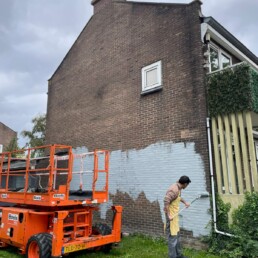
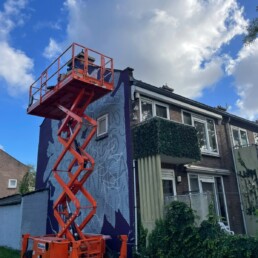
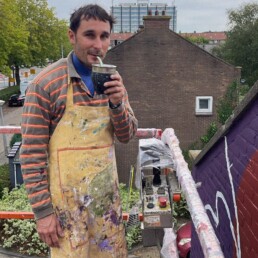
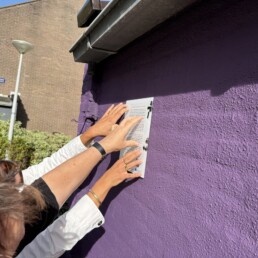
Last week, we celebrated the opening of “Flower of the Dichtersbuurt” with the people who matter most: the neighbours. Local residents, friends and partners gathered around the new mural to see it up close, share a drink and talk about what a greener, cooler neighbourhood could look like. We were incredibly lucky with the weather, and the sunshine made for a fitting setting for a mural that celebrates nature in full bloom.
What stood out most was the excitement in the neighbourhood. People were curious, proud and eager to talk about the artwork, and many were already imagining how it would brighten their daily walks past it. The afternoon was a reminder of what the Cities, Not Saunas campaign is all about: bringing people together, sparking conversations and celebrating communities acting for change.
Interview with Anna, Founder & Program Director of Street Art Museum Amsterdam (SAMA)
- What does SAMA see as the power of street art in starting conversations about issues like climate change?
For SAMA, the power of street art is that it takes a very large and sometimes abstract subject and places it directly into people’s everyday environment. Climate change can feel distant to an average person in Dichtersbuurt, for example: statistics, policies, international conferences, temperatures in the future. A mural makes the conversation physical and local. You encounter it while walking home, taking your children to school or a swimming lesson (as one of the little girls told me – I saw it on my way to a swimming pool) or going to the supermarket (one of the residents commented “I go to Deka markt once a day, and now I get a smile as well, when I see the mural”). You do not need to enter a museum or already be interested in climate policy to come across it. Street art also doesn’t have to provide an answer. It can create a point of curiosity and start a conversation. That is particularly important with a subject like climate change, where fear and enormous amounts of information can sometimes make people disengage rather than act. Here, instead of showing catastrophe, we chose growth.
- Why did you choose to work with CICLOPE for this mural and theme?
We were looking for artists who could translate the climate message into something that belonged to the Dichtersbuurt, rather than simply illustrating a campaign on a wall. CICLOPE gave us that possibility. Their visual language is bold and contemporary, but also organic, playful and accessible – and their proposal of flowers growing out of the urban environment immediately connected with a much longer story within SAMA. In fact, seeds and flowers have been part of SAMA’s language for years. With Today Seeds, Tomorrow Flowers, we explored the idea that cultural and social change begins by planting something small today whose impact may only become visible later. That thinking continued through All Inclusive, where art became a tool for connection and dialogue in the Dichtersbuurt, and eventually became quite literal with our Buurttuin van Verhalen – Garden of Stories: a community garden where growing plants, sharing stories, meeting neighbours and preserving the memory of a neighbourhood that is about to change all come together.
The climate message could be expressed through something we already understood very well: one bulb → flowers → a greener neighbourhood → a climate-resilient city. There is something important in that simplicity. A bulb is tiny. You put it into the ground and, for a while, seemingly nothing happens. But with the right conditions and care, it grows. For us, that is also a metaphor for community work and for the kind of long-term cultural practice SAMA has been developing in Nieuw-West. CICLOPE’s artistic language allowed us to bring all these layers together without losing the artwork itself. The flowers emerge from the concrete; nature is not presented as the opposite of the city, but as something that can grow through it and transform it. And in a neighbourhood facing demolition, rebuilding and densification, that image suddenly carries another meaning as well: what are we planting today in the neighbourhood that people will live in tomorrow? SAMA also understands co-creation that way. It is not about asking an artist to illustrate everybody else’s ideas. It is about creating the conditions in which the history of a place, the knowledge and wishes of its community, the commissioning partner’s message and the artist’s own visual language can meet, and produce something none of us would have created alone.
- What makes this project different from other murals SAMA has developed? What interested you about creating a mural for the Cities, Not Saunas campaign?
Every mural SAMA develops begins with its location, but this one quite literally began on the pavement outside De Dichter. I pumped into our neighbour Rob Spithorst, who turned 80 this year. For almost 30 years, Rob has been an informal guardian of the Dichtersbuurt and is one of the co-founders of De Dichter buurthuiskamer. He knows this neighbourhood, its people and its stories intimately. Rob was standing near the wall with a bag of flower bulbs he was about to plant. He looked at the empty wall next to De Dichter and suddenly said: “Why don’t you paint this wall next, with some beautiful bulb flowers from our neighbourhood?” I remember answering: “Absolutely. I even have an artist in mind already.”
And that was it. Just Rob, a bag of bulbs, an empty wall and an idea. Six months later, when WECF approached us with the brief for Cities, Not Saunas, the project almost made itself. The challenge was never to simply place an international climate campaign onto a local wall. Instead, we asked: what does Cities, Not Saunas actually mean here, in the Dichtersbuurt? And strangely enough, the neighbourhood had already given us the answer. It was in Rob’s bag of bulbs. The project became less about communicating climate change as an abstract global issue and more about imagining what kind of neighbourhood people want to live in as the Dichtersbuurt changes: one with trees and shade, flowers and biodiversity, places to meet, and public space designed around human beings. That is where WECF’s campaign and SAMA’s place-based practice came together so naturally. The global message arrived later; the local story was already here, waiting to grow.
- Why is the message particularly relevant to the Dichtersbuurt?
Because the Dichtersbuurt is literally changing in front of us. Buildings will disappear, new homes will be built and the neighbourhood will become more densely populated. These moments of urban transformation are also moments when decisions are made about what kind of city we are creating for the next generation. Density itself does not have to be the problem. The question is what comes with it. Is there enough green? Is there shade? Is there space for people to meet? Can rainwater go somewhere? Does public space remain pleasant during increasingly hot summers? And do the people who already live here have a voice in imagining that future? That is why I find the image of the flowers particularly hopeful. The mural is temporary, just as this phase of the neighbourhood is temporary. But the idea it represents can continue into what comes next. One of the things we have learned from working in the Dichtersbuurt is that people care enormously about their immediate surroundings. Discussions that sound very abstract at city level become very concrete here: a tree, a bench, a garden, a wall, a place where neighbours meet. Perhaps that is the most important connection between the mural and the neighbourhood. Climate resilience does not begin with the word “climate”. It begins with the question: what kind of place do we want to live in?
5. Final thoughts from Anna
For us at Stichting Street Art Museum Amsterdam, the mural is not really the final product. The artwork is the process. The painted wall is simply the most visible moment in a much longer conversation about the Dichtersbuurt, its transformation and the people who live here. In fact, one of the most important moments happened only after the inauguration was over. Local kids started playing football with Julio — because, of course, he is from Argentina — while a group of girls surrounded Pilar to show her how they make flower collages from flowers they pick in the Buurttuin, just like the flowers they now recognised on their mural. Suddenly, the artwork was no longer something we had made for the neighbourhood. It had entered their world. And that is ultimately the goal: for the neighbourhood to love it, appropriate it and make it their own. When I saw that a local Muslim woman had photographed the mural and her picture was suddenly travelling around Facebook, I thought: my job is done. Not because the mural had gone viral, but because someone who is rarely given a voice in how public space is represented had chosen to represent her neighbourhood through it. We had empowered someone to become part of its story. So if somebody stops in front of those flowers and starts talking to their neighbour about what should grow in the neighbourhood that comes next, the mural is doing its job. And that process does not end with the inauguration. It will continue for as long as the mural is alive — perhaps six years — through encounters, photographs, conversations, memories and new meanings that we cannot predict yet. That impact is still to be recorded. Because the artwork is not finished when the artist puts down the brush. In many ways, that is when it begins.
Interview with Julio & Pilar, the artists behind CICLOPE
For us, the opportunity to paint in Amsterdam was a wonderful experience and also our first mural in the city. Although we had visited Amsterdam before, we didn’t know the Sloterdijk neighbourhood. During the days we spent painting, we gradually discovered its identity and, above all, got to know the people who live there.
1. Why do we think it is important to use art to support a cause like Cities, Not Saunas? We believe that art has the ability to bring people closer to issues that can often seem distant or difficult to approach. When facing a challenge like climate change and rising temperatures in cities, a work of art can start a conversation in a way that feels more familiar, sensitive and accessible.
We especially like that a mural does not have to explain everything literally. An image can spark curiosity, raise questions and encourage people to stop, look and think about the place where they live. In that sense, we believe art can help us imagine different ways of living in our cities: greener, cooler and better cared for.
- What makes this mural different from other work we have created, particularly in how we approached the Cities, Not Saunas theme?
Flowers of the Dichtersbuurt feels different to us because it grew directly out of the place and the people who live there. We often work with flowers and elements of nature in our murals, but in this case, the flowers have a very specific connection to the history and identity of the neighbourhood.
The crocus, daffodil and dahlia came up in our conversations as flowers that local residents would recognise. We were interested in taking these elements that were already part of the neighbourhood and transforming them into a new image for it.
We also really liked the idea of the mural being part of a moment of transformation. We did not want it to represent a farewell or to create a nostalgic piece. Instead, we wanted to speak about the roots of a place and how those roots can remain present in its future.
In relation to Cities, Not Saunas, we decided to approach the theme in a less literal way. There are no images of extreme heat, thermometers or warnings. Instead, we chose to express an idea of hope: that through small things—a flower, a plant, a green space, some shade—we can begin to imagine cooler and more resilient cities.
- If someone had only ten seconds to look at this mural, what would we hope they feel or understand?
We would like them to feel that there is life growing and that nature can be part of the city in a very immediate and tangible way.
We would also like them to recognise something that belongs to the neighbourhood. Perhaps they see a flower and think, “I know that flower,” or it reminds them of a garden, a plant or a place that forms part of their own story.
Above all, we hope that during those ten seconds they experience a positive feeling of colour, nature and hope. We would like the mural to convey that solutions to climate change do not always have to feel distant or enormous: they can also begin in our own neighbourhood.
- If this mural could inspire one small action from someone in the neighbourhood, what would we hope that action would be?
We would love for someone to feel inspired to care for or plant something in their surroundings. It could be something very small: a plant on a balcony, or simply paying more attention to the green spaces that already exist.
On our daily journey to the wall, we passed through parks, places for sports, and spaces where people could sit and enjoy nature. Once we arrived in the neighbourhood, we also had many encounters with local residents.
Some older residents would come over to show us things they had made, such as tote bags and dolls. Even though we did not always share a common language, we found other ways to communicate, and they showed us a great deal of warmth and joy. Children also came by every day on their bicycles and even gave us drawings featuring Messi’s football shirt.
One local resident, Jana, spent time with us during several days of painting. She was very happy with the mural, and whenever someone walked past, she would ask them what they thought of it. That kind of participation was very special to us because it made us feel that the mural was beginning to belong to the people who live there as well.
Perhaps that is what we would most like to happen: for the artwork not to remain simply a painting on a wall, but to create a connection with the place and with the nature that already exists in the neighbourhood—and to inspire people to continue caring for it and helping it grow.
Thank you very much for inviting us to be part of this campaign and for giving us the opportunity to discover and paint in this neighbourhood. For us, it was a wonderful and meaningful experience.

