
The Future of Development Cooperation needs a feminist focus
On 11 and 12th of May 2026, our director Sascha Gabizon joined FEMNET’s director Memory Kachambwa for the “Future of Development Cooperation” conference at the offices of the Organisation for Economic Cooperation and Development (OECD) in Paris to give input to their discussion on the future of development cooperation.
What is the OECD?
The OECD brings together industriaized countries mostly from the Global North, to do research, coordinate policies and develop technical guidelines, including on Development Cooperation. The membership of the OECD includes industrialized countries (EU states, North America, Japan, Australia and New Zealand) and increasingly middle-income countries like Mexico, Chile, Costa Rica and Colombia.
An important tool now widely used are the “gender markers” developed by the GENDERNET of the OECD-DAC (DAC stands for Development Assistance Committee). The handbook on the OECD DAC Gender Equality Marker Policy marker shows how funders are applying the marker to ensure funding is spend in a gender-responsive manner, using a 3-level scoring system.

Analysis of a changing world
The OECD presented their 2026 report on Multilateral Development Finance in a changing world, showing that for the first time finance is declining fast, expected to be 30% below previous levels by 2027. This is a crisis situation, because the ‘bad’ guys (organised crime and bad governments) are powerful, and the response of the ‘good’ guys has to be increased multi-lateral cooperation. However, what we are seeing is less funding, and funding where the focus is no longer on supporting the 60% extreme poor who reside in fragile countries, but increasingly a focus on economic cooperation with middle income countries. At the same time, lessons show that the ‘private sector’ has not proven to be a solution to providing more funding. And private philanthropy only contributes about 10% of funds. Overall, the OECD analysis shows a very bleak picture!
Feminists perspectives
Our WomenPower2030 partner Memory Kachambwa of FEMNET spoke in the policy-maker roundtable on identifying purposes of international development cooperation, as the only civil society and feminist speaker. She stressed that in Africa over 80% of employment is in informal economies, and the majority work being done by women. We need to invest not just in women’s economic inclusion, but to ensure to integrate women into a JUST economic system, and for that we need to reform the global financial architecture. For that OECD countries must continue to pursue the use of the Gender Equality Marker, ESPECIALLY when funding is shrinking. However, we see that donors are abandoning gender focussed funding for feminist and civil society organisations. Now more than ever, developing funding should support a redistribution of power – away from the extreme rich – should not be favouring extractivist models, but should and prioritize justice and allocating resources to repair historical injustices and inequalities. ODA funding must be more courageous and flexible, and allow feminist civil society organisations to create endowment funds to blend grants, guarantees and loans for locally led transitions.
Locally-Led Development
A coalition of Member States (Netherlands, Austria, Spain, UK, Australia) and organisations presented their push for a different type of cooperation, focussing on ‘Locally-Led Development’, aiming for more co-creation of solution with local actors, more and quality financing to local actors, simplified due-diligence and risk-sharing processes, locally-led evaluation and monitoring, and a stronger role for international intermediaries (such as civil society organisations and their networks).
Sascha Gabizon, our executive director, added that locally-lead does not automatically lead to gender-just solutions, – as our societies remain patriarchal – and that therefore we need to invest in feminist approaches and support for women’s rights organisations and women-led initiatives.
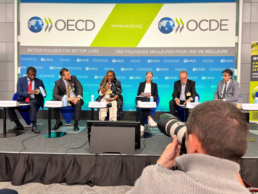
FEMNET’s director Memory Kachambwa speaking at the OECD conference (photo credit: WECF)
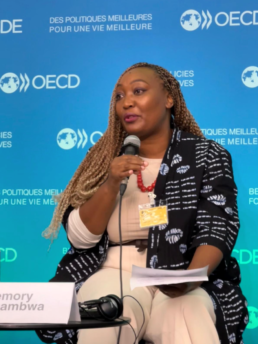
FEMNET’s director Memory Kachambwa speaking at the OECD conference (photo credit: WECF)

