
In 2024, donors gave women’s rights and feminist organisations $578 million, 28% less than the year before. That is roughly two hours of global military spending. The Prospera network estimates its members lost a further $676 million in 2025, with many reporting budget cuts of around 30%.
On 22 October, WECF members and partners from Tunisia, Nigeria, Argentina, Kazakhstan, Cameroon, the Netherlands and other countries met online to talk openly about what this means for their work, and what they can do about it. The session was part of our Women Power 2030 series on feminist movement building.
What’s closing, and what’s still open
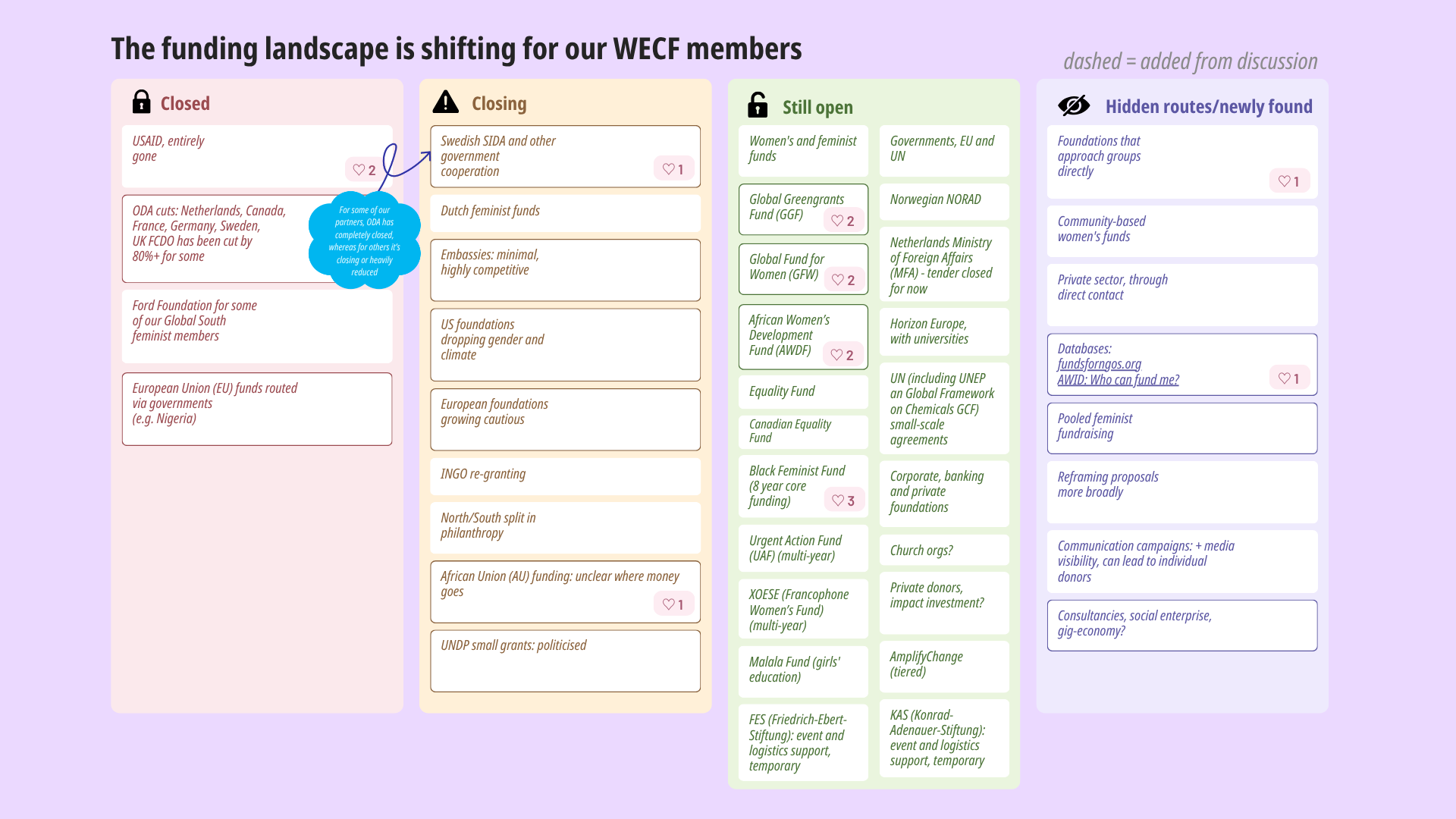
Together, participants mapped the funding landscape. USAID is gone. Ford Foundation has pulled back from women’s rights work in several countries. UK and European government funding for international cooperation is shrinking, and EU civil society funding is expected to fall further in the next budget cycle (2028–2034).
There are still openings. Feminist and women’s funds, including Global Fund for Women, Black Feminist Fund, AmplifyChange and African feminist funds offering multi-year grants, are still giving. Participants also pointed to less obvious routes: Horizon Europe research partnerships, small UN agreements, political foundations and church organisations.
Lessons from practice
Drawing on years of grant-seeking in Central Asia, one of our speakers shared practical advice: start from your organisation’s strengths instead of chasing open calls. Read a funder’s eligibility rules as carefully as its priorities. Use consortiums so smaller organisations can access larger grants, with local partners shaping the project and budget from the start. And stay in touch with donors long after the final report.
Competition between allies
The discussion kept returning to one question: what happens to a movement when its organisations are pushed to compete with each other for less and less money? Participants shared how this plays out, from EU rules that require organisations to compete, to networks competing with their own members. They also discussed alternatives, such as pooled fundraising modelled on the Plastic Solutions Fund and pushing donors to fund ecosystems and networks rather than single organisations. Each organisation also needs to be clear about its red lines: which funders it will accept, and on what terms.
This article was produced as part of Women Power 2030, a programme by APWLD, FEIM, FEMNET, WECF and WEP to strengthen women’s rights organisations and feminist movements. Women Power 2030 is funded by the European Union. Views and opinions expressed are those of the authors only and do not necessarily reflect those of the European Union. Neither the European Union nor the granting authority can be held responsible for them.

