
Event Recap: Women and Chemicals — Everyday Exposure, Hidden Risks, and the Fight for a Toxic-Free Future
Chemicals are part of our everyday life. They are in the cosmetics we use, the food we eat, the pesticides sprayed on crops, and the products we bring into our homes. But exposure is not the same for everyone. Gender roles, working conditions, care responsibilities, and social expectations all shape who is most exposed and who is most protected.
On March 26th, 2026, WECF organised a one-hour interactive webinar called Women and chemicals: everyday exposure, hidden risks and the fight for a toxic-free future, as part of the Imagining a Climate Just Futures (ICJF) series on the link between gender, chemical exposure, and environmental justice. The discussion asked an important question: what do we really mean by a toxic-free future, and for whom?
Our consultant, Clara Presman moderated the session, opening with the reminder that environmental problems are not only technical issues to be solved through innovation or efficiency. They are also social and political questions, deeply connected to inequality, labour, consumption, and gender norms. She pointed to menstrual products as one example of how stigma, silence, and policy gaps can shape both exposure and health risks, while also highlighting the environmental and economic implications of the mostly single-use products still dominant on the market.
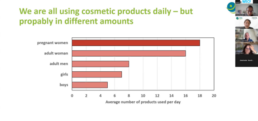
The webinar also hosted two expert speakers. Esther Smollich, Senior Science and Policy Officer in the Health and Chemicals Programme of the Health and Environment Alliance (HEAL), focused on cosmetics and personal care products. She explained that women and girls use significantly more cosmetic products than men and boys, often from a very young age, because of social expectations around appearance and hygiene. Pregnant women and babies are also particularly exposed and vulnerable. Esther explained how EU cosmetics legislation includes important protections, but still have major gaps, especially when it comes to the combined effects of multiple chemicals and the regulation of endocrine disruptors.
Between speakers, participants identified cosmetics and cleaning products as key exposure areas in a live poll. Esther explained that product labels are useful but often difficult to understand, and that non-compliant products still appear on the EU market, including through online sales.

Our second speaker, Margriet Mantingh, co-founder and chairperson of PAN Netherlands, turned to pesticides in food, flowers, homes, and gardens. She showed that fruits like strawberries and citrus, and vegetables such as salads, often contain higher pesticide residues, while root vegetables and avocados tend to be less contaminated. Pesticides are also found in cut flowers, garden plants, and even household dust. She also mentioned global inequalities: pesticides banned in the EU are still used elsewhere in the world, affecting workers, often women and ecosystems.
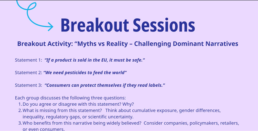
In breakout rooms, participants discussed statements like “If a product is sold in the EU, it must be safe.” Many questioned this assumption, pointing to gaps in regulation, enforcement, and global inequalities. Discussions on pesticides also raised questions about food systems, affordability, and the need for more sustainable alternatives.
The session concluded with practical questions. Rinsing fruits can reduce some pesticide residues, but not all, as many are absorbed into the plant. Participants also noted that chemicals in packaging are often overlooked.
Overall, the webinar showed that chemical exposure is not just an individual issue. It is shaped by policies, markets, and social norms. A truly toxic-free future must therefore address inequality and ensure that protection reaches those most exposed.
Our final Webinar will be on April 24th at 13:00 CET, Connecting the Dots: Living the EU Green Deal in everyday life and preparing for Summer.

